
Park Holidays content transformation
dhex helped Park Holidays make 160+ priority pages easier to find, navigate and maintain. Customers gained clearer routes to booking a holiday or exploring holiday home ownership, while the team gained a more consistent, manageable content estate.
Our contribution
We led content strategy and delivery within Park Holidays’ wider digital transformation, working across the Growth Team, Marketing, Product and development, alongside external UX partner MentorMate.
Our work covered stakeholder discovery, content auditing and prioritisation, content modelling, taxonomy and CMS component reviews. We also established the shared standards and ways of working that supported consistent content delivery.
CMS: Contentstack
At a glance
- Audited and prioritised more than 160 high-priority pages across more than 400 pages in total
- Built a weighted scoring framework to prioritise work by business value and customer impact
- Redesigned key journeys across holidays and holiday home ownership
- Introduced governance, content standards and clearer ownership
The problem
Park Holidays UK is one of the UK’s leading holiday park operators, with more than 50 parks across England, Scotland and Wales. The business offers holidays, touring and camping, and holiday home ownership, welcoming hundreds of thousands of guests every year.
Its website is one of the company’s most important customer touchpoints, helping people discover parks, compare accommodation, plan holidays and make booking decisions.

As Park Holidays continued to grow, so did the scale and complexity of its website. Hundreds of pages had evolved over time to support new products, campaigns and business priorities, making the website increasingly difficult to manage while creating an inconsistent experience for customers.
The opportunity extended beyond improving individual pages. Park Holidays was embarking on a wider digital transformation, making it the ideal time to establish stronger content foundations, improve governance and create a more sustainable operating model for the future.
We focused on the systems behind the content, where the biggest improvements were possible.
Discovery and stakeholder interviews
We began with stakeholder interviews to understand the challenges from different perspectives. Natasha approached these conversations with an open mind, listening to what teams were trying to achieve, where they were experiencing difficulties and what needed closer investigation.
These conversations helped us clarify the underlying problems and shape the focus of the content audit and CMS review. We considered stakeholder insight alongside customer research and performance data, developing recommendations that reflected customer needs, commercial priorities and delivery constraints.
What we found
As Park Holidays continued to invest in its digital transformation, there was an opportunity to make better use of its headless CMS by creating a more consistent, scalable approach to content. We expanded the programme beyond page design to understand how customer journeys, reusable components, information architecture and governance could work together.
We examined the whole system across pages, components and governance:
- how customers moved through key journeys
- where pages duplicated information
- how reusable CMS components shaped the customer experience
- where we could introduce greater consistency
- how content supported commercial objectives
- how content could scale more effectively as the business grew
By connecting these different areas, we identified opportunities that wouldn’t have been visible through a traditional page-by-page content audit.
One of the biggest challenges was deciding where to focus first. With hundreds of pages across multiple customer journeys, we needed an objective way to prioritise work. We used dhex’s weighted content scoring framework, assessing every page against factors including strategic business value, customer need, journey importance, accessibility, user experience, SEO opportunity, conversion potential, content quality and maintenance effort.
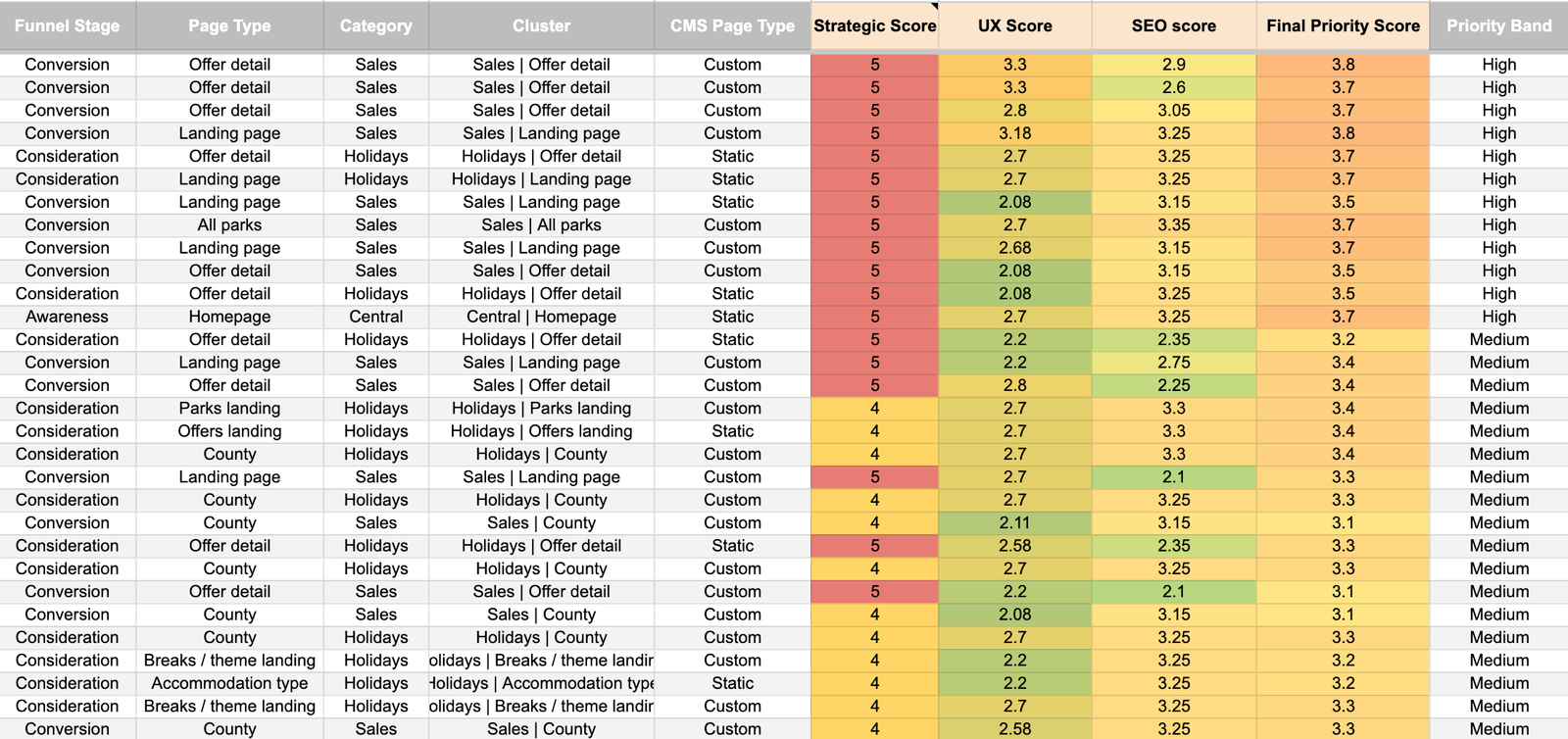
The framework created a transparent way to prioritise investment and gave the business confidence that we focused effort where it would have the greatest impact.
What changed
Audit and prioritisation
We audited and prioritised more than 160 high-priority pages across more than 400 pages in total, using the weighted scoring framework to focus effort where it would have the greatest impact. The framework has since become the foundation for future planning and continues to support decision-making beyond the initial programme.
Building the content operating model
To support delivery across hundreds of pages, we established a shared way of planning, prioritising, creating and reviewing content. The operating model connected the Growth Team with Marketing, Product, development and MentorMate, giving colleagues a clearer understanding of priorities, responsibilities and how their work fitted together.
It brought together four practical elements:
- Clear priorities: A weighted scoring framework helped the team decide where to focus, based on customer needs, commercial value and opportunities for improvement
- Ownership and collaboration: Clearer responsibilities and structured conversations connected content, UX, SEO, Product, Marketing and development, helping teams resolve questions and agree next steps
- Standards and quality: A style guide, editorial standards and reusable Page Review Checklist supported consistent delivery across different content types
- Measurement: Audit findings, search insight and performance data informed recommendations and helped the team prioritise improvements
Together, these gave the team a repeatable approach to improving content, with processes and guidance they could continue using beyond the programme.
Natasha brought a huge amount of structure and clarity to the programme from day one. The planning and prioritisation processes simply didn't exist beforehand. She quickly got to grips with our entire data set, built the scoring framework behind the scenes, and made sure everyone understood what we were doing and why. It gave me complete confidence because I knew she understood the full scope of work. Even better, those processes are something we'll continue using within the team long after the project has finished.
Kelly Johnstone
Head of Brand & Content, Park Holidays
Priority-page improvement
We worked collaboratively to redesign revenue-generating journeys across holidays and holiday home ownership, improving content, accessibility, clarity and consistency. Content, UX and SEO shaped one another throughout, so decisions balanced customer needs, search intent and CMS constraints rather than being handed from one team to another.
I had an absolute trusted pair of hands. I could step away knowing Natasha had organised everything, and I knew the delivery would continue.
Kelly Johnstone
Head of Brand & Content, Park Holidays
Content modelling, taxonomy and CMS structures
We reviewed CMS components, content structures and reusable content patterns in Contentstack, assessing how well they supported customer journeys and everyday content delivery.
Natasha worked closely with Product, development and external UX partner MentorMate on content modelling.
Team enablement
The team brought together expertise across content design, SEO and digital strategy:
Natasha Drewnicki
Content Design Lead, Transformation Strategy
Led content strategy and delivery within Park Holidays' wider digital transformation. Her remit included stakeholder interviews, content auditing and prioritisation, content modelling, taxonomy, CMS component reviews and governance, ensuring consistently high delivery standards. She worked across the Growth Team, Marketing, Product and development with external UX partner MentorMate.
Becki Warren-Crossley
Content Designer
Led user research and content design, translating customer insights into clearer journeys and more intuitive content. Becki helped ensure recommendations were grounded in real user needs rather than assumptions.
Aron Clinch
SEO Specialist
Provided SEO strategy and search insight throughout the programme, ensuring content decisions reflected customer intent, technical performance and opportunities for long-term organic growth.
The results
The programme delivered measurable improvements across search performance, customer journeys and the systems supporting Park Holidays’ content. All figures relate to the prioritised pages and were measured during the programme.
Stronger performance across targeted content
- 18.3% increase in organic clicks
- 26.7% increase in search impressions
- 78.6% improvement in click-through rate, rising from 2.8% to 5%
- Average search position improved from 13.6 to 9
Note: these figures are drawn from the original programme reporting and should be verified against the source data, as the relative changes in clicks, impressions and click-through rate are not internally consistent.
A more scalable content operation
- Key holiday and holiday home ownership journeys redesigned
- A weighted scoring framework introduced to prioritise work by customer need, commercial value and performance opportunity
- New content standards, templates and governance created for future teams
- A clearer content model established to improve consistency and support reuse across the wider website
The wider commercial picture
During the programme, sessions across the website increased by 38.9%, transactions by 20% and revenue by 28.7%.
As the work formed part of a broader digital transformation, these results can’t be attributed to content alone. However, they demonstrate the direction of travel as content, UX, SEO and product improvements came together.
Park Holidays wasn’t left with a one-off batch of rewritten pages. The team now has a repeatable way to identify what needs improving, prioritise the work, measure its impact and apply what works across more than 400 pages.
What changed for the team
Strong content performance isn’t created on the page alone. It depends on what sits behind it: clear priorities, shared ownership, reusable components, reliable evidence and teams making decisions together.
By improving those internal systems alongside the customer experience, we created a foundation that can keep delivering value, making future content faster to improve, easier to manage and more likely to perform.
What other travel brands can learn
Travel brands carry large, complex content across booking, ownership, destinations and support. The Park Holidays programme points to a few repeatable lessons for teams in a similar position:
- Prioritise with evidence, not opinion. A weighted scoring framework turns a sprawling website into a defensible order of work
- Connect content, UX, SEO and CMS work. Decisions made together across disciplines reduce duplication and rework
- Treat components as part of the content system. Content modelling and reusable components make consistency scalable
- Build governance alongside the content. Standards, ownership and measurement are what keep improvements holding after the project ends

Talk to dhex about your content
Tell us where customers or teams are getting stuck. We'll help you work out what's causing it and where to begin.